
The Problem
Organizations across industries face the same structural challenge: complex workflows that span multiple domains of expertise, each requiring specialized knowledge, different tools, and manual handoffs between teams. A compliance assessment touches security, infrastructure, policy, and documentation. An ATO package requires evidence from dozens of AWS services mapped to hundreds of NIST controls. A proposal response needs market research, technical writing, past performance matching, and compliance validation.
Today, these workflows are stitched together with spreadsheets, email chains, and tribal knowledge. Single-purpose AI tools solve one piece but don't collaborate. The result: slow execution, lost context between steps, and expertise that walks out the door when people leave.
The Platform
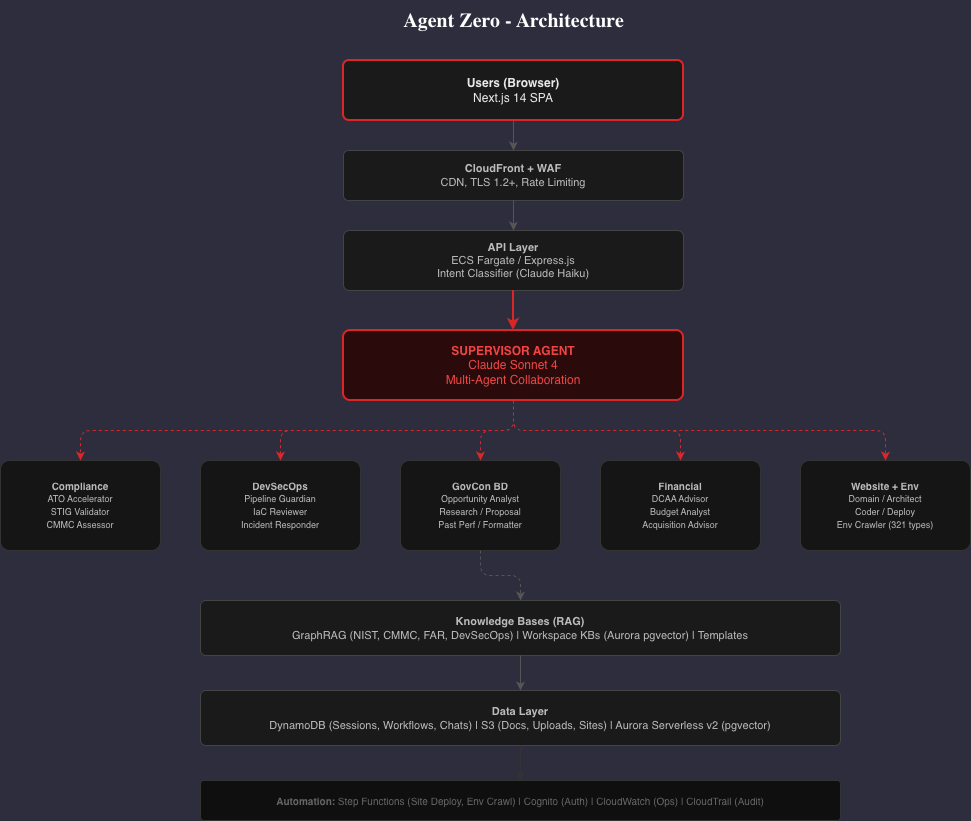
Nexus Zero is a multi-tenant AI orchestration platform built on AWS Bedrock's native multi-agent collaboration. Rather than building one AI tool for one task, Nexus Zero provides the infrastructure for deploying teams of specialized AI agents that work together through a single Supervisor.
You define the agents, their expertise, and their knowledge bases. The Supervisor routes requests to the right specialist, agents query shared and workspace-scoped knowledge bases, and multi-step workflows run with iterative quality checks. The platform handles orchestration, context persistence, document understanding, and multi-tenant isolation.
At the core is a GraphRAG knowledge architecture: structured reference knowledge bases (NIST 800-53, CMMC 2.0, FAR/DFARS, CIS Benchmarks, DevSecOps best practices) combined with workspace-scoped vector stores (Aurora pgvector) that hold each organization's documents, policies, and institutional knowledge. Every agent draws from both layers, giving it regulatory context and organization-specific awareness.
Architecture
Compliance and ATO Agents (Deep Dive)
The compliance cluster is the most mature area of the platform, purpose-built for the federal ATO and continuous monitoring lifecycle:
- ATO Accelerator: Generates System Security Plan (SSP) sections, maps system components to NIST 800-53 Rev 5 controls, tracks Plan of Action and Milestones (POA&M), and produces eMASS-compatible documentation packages. Pulls from the GraphRAG knowledge base covering all 367 FedRAMP High controls
- STIG Validator: Validates configurations against DISA Security Technical Implementation Guides. Categorizes findings by severity (CAT I/II/III), generates remediation commands, and tracks compliance status across system components
- CMMC Assessor: Evaluates CMMC 2.0 readiness across all three levels. Calculates SPRS scores, identifies gaps against required practices, and produces remediation roadmaps with prioritized action items
- Environment Crawler: Scans live AWS environments across multiple accounts via Step Functions. Discovers 321+ resource types, maps findings to CMMC, NIST 800-53, Zero Trust, and CIS frameworks, and feeds results to the compliance agents for automated assessment
- Pipeline Guardian (DevSecOps): Analyzes CI/CD pipelines against DoD DevSecOps reference design. Validates SBOM generation, container scanning, and artifact signing. Ensures pipelines meet the security gates required for ATO
- IaC Reviewer (DevSecOps): Reviews Terraform, CDK, and CloudFormation templates against CIS benchmarks and organizational security policies. Catches misconfigurations before they reach production
Together, these agents cover the full compliance lifecycle: scan the environment, assess against frameworks, generate documentation, identify gaps, and produce remediation plans. What typically takes a compliance team weeks of manual work runs in minutes through a single chat interface.
All 18 Specialist Agents
Compliance
ATO Accelerator, STIG Validator, CMMC Assessor
DevSecOps
Pipeline Guardian, IaC Reviewer, Incident Responder
GovCon BD
Opportunity, Research, Proposal, Past Perf, Formatter
Financial
DCAA Advisor, Budget Analyst, Acquisition Advisor
Website + Env
Domain Scout, Architect, Coder, Deploy, Env Crawler
Example Workflow: Environment Compliance Audit
Example Workflow: RFI Pursuit Pipeline
Beyond GovCon: A General-Purpose Platform
The current deployment targets federal contracting and compliance, but the platform architecture is domain-agnostic. The same Supervisor + specialist agent + GraphRAG pattern applies anywhere you have multi-step, multi-expertise workflows:
Healthcare Operations
HIPAA compliance agents, clinical protocol advisors, audit documentation generators, and patient data governance specialists.
Financial Services
SOX compliance, risk assessment, regulatory reporting, and fraud detection agents working from shared regulatory knowledge bases.
Enterprise IT
Incident response, change management, capacity planning, and security posture agents collaborating across infrastructure domains.
Legal and Procurement
Contract review, clause analysis, vendor risk assessment, and compliance verification agents with organization-specific policy knowledge.
To deploy Nexus Zero for a new domain: define the specialist agents, load the relevant knowledge bases, configure the workflows, and deploy. The platform infrastructure (auth, orchestration, multi-tenancy, cost management) is reusable.
Results
- Single chat interface for all 18 specialist agents across 5 domains
- Full ATO lifecycle from environment scan to SSP generation to POA&M tracking
- GraphRAG knowledge layer with NIST 800-53, CMMC 2.0, FAR/DFARS, CIS, and DevSecOps reference material
- Multi-tenant workspaces with per-tenant knowledge bases (Aurora pgvector)
- Auto-destroy cost management: API infrastructure tears down after 24h inactivity
- Portable IaC: Zero hardcoded account IDs, deploys to any AWS account via 5 CDK stacks
- Domain-agnostic: Same platform architecture applies to any multi-agent workflow
Technology Stack
Security
- Cognito authentication with MFA, 12-char password policy, email verification
- WAF with AWS Managed Rules + IP rate limiting (2000 req/IP)
- Encryption at rest (S3, DynamoDB, Aurora, ECS) and in transit (TLS 1.2+)
- VPC isolation for compute and database layers
- IAM least-privilege policies per service
- Bedrock Guardrails with content filtering and PII detection
- CloudTrail audit logging across all services